


 中文简体
U srcu svakog sustava reverzne osmoze nalazi se tanka, skromna membrana koja obavlja težak zadatak pročišćavanja vode. RO membranes are used in household drinking water purifiers, brackish water treatment, industrial process water, and even seawater desalination. But how does an RO membrane work? In this guide, we explain the principle, structure, and operating conditions behind this remarkable filtration technology, and what it means for choosing and maintaining the right membrane.
The Science Behind Reverse Osmosis
Izraz "reverzna osmoza" ima smisla samo ako prvo razumijete normalnu osmozu. Osmosis is a natural process in which water moves through a semipermeable membrane from a region of lower solute concentration to a region of higher solute concentration, trying to balance the two sides.
Natural Osmosis vs. Reverse Osmosis
U prirodnoj osmozi pokretačka sila je razlika osmotskog tlaka. If you place saltwater on one side of a semipermeable membrane and fresh water on the other, pure water gradually travels into the saltwater side until the concentrations equalize.
Reverse osmosis simply reverses this flow. By applying external pressure to the feed side, at a level greater than the natural osmotic pressure, water molecules are forced to move from the high-concentration side to the low-concentration side. Salts and most other dissolved contaminants cannot pass through the membrane, so they are left behind in a concentrated stream, known as concentrate or brine water.
Zbog toga RO sustav uvijek proizvodi dva toka: pročišćeni permeat i koncentriranu otpadnu vodu.
Anatomy of an RO Membrane
Većina modernih RO membrana su membrane od kompozita tankog filma (TFC), izgrađene od tri različita sloja koji rade zajedno.
- Non-woven polyester fabric: The backing layer that gives the membrane mechanical strength to withstand operating pressure.
- Polysulfone support layer: Mikroporozni srednji sloj koji daje glatku, ujednačenu površinu za aktivnu barijeru.
- Poliamidni tanki film: Gornji aktivni sloj, debljine manje od mikrona, koji zapravo vrši odbijanje. Ovaj gusti, umreženi polimer omogućuje molekulama vode prolaz dok blokira otopljene soli, organske tvari i mikroorganizme.
In a typical spiral-wound element, these flat sheets are sealed into envelopes, wrapped around a central permeate collection tube, and separated by mesh spacers that create flow channels for feed water and concentrate.
How Water Passes Through an RO Membrane
Kretanje vode kroz membranu nije jednostavan efekt sita. It can be broken down into four stages:
- Tlak: Pumpa podiže tlak napojne vode znatno iznad osmotskog tlaka otopine. In household systems, this is usually a 12V or 24V booster pump.
- kontakt: Pressurized feed water flows across the membrane surface, and water molecules begin to dissolve into and diffuse through the polyamide active layer.
- odvajanje: Otopljene ione i organske molekule odbija nabijena, umrežena polimerna struktura i ostaju na strani punjenja.
- zbirka: The purified water that emerges on the permeate side travels along the membrane envelope and into the central tube, while the concentrated reject stream is flushed out of the element.
This mechanism is often described as solution-diffusion: water partitions into the membrane material, diffuses through it, and emerges on the other side. Onečišćenja koja se ne mogu otopiti u ili difundirati kroz aktivni sloj se zadržavaju.
What an RO Membrane Removes
RO membranes are best known for rejecting dissolved salts, but their rejection range is much broader. Donja tablica sažima tipične stope odbijanja za uobičajene skupine kontaminanata.
| Kategorija zagađivača | Tipična stopa odbijanja | Primjeri |
|---|---|---|
| Ukupna otopljena krutina | 95-99% | Sodium, calcium, chloride, sulfate |
| Teški metali | 90-99% | Lead, arsenic, chromium, copper |
| Mikroorganizmi | Preko 99,9% | Bakterije, virusi, ciste |
| Organski spojevi | 90-98% | Pesticides, herbicides, VOCs |
Stope odbijanja ovise o vrsti membrane, radnom tlaku, temperaturi vode i kemiji napojne vode. Visokotlačne membrane dizajnirane za desalinizaciju morske vode, na primjer, odabrane su posebno zbog svoje učinkovitosti odbijanja soli.
Key Factors That Affect RO Membrane Performance
A membrane does not work in isolation. Učinak u stvarnom svijetu ovisi o nekoliko radnih uvjeta:
- Pritisak napajanja: Higher pressure generally increases permeate flow, but exceeding the maximum operating pressure can damage the membrane.
- Temperatura vode: Membranes produce more water at higher temperatures. Kao pravilo, protok se mijenja za oko 3% po stupnju Celzijusa.
- TDS napojne vode: Veće opterećenje solju znači viši osmotski tlak, pa je potrebno više energije za postizanje istog protoka.
- pH razina: TFC membrane obično najbolje rade u pH rasponu od oko 2 do 11. Ekstremne vrijednosti mogu degradirati poliamidni sloj.
- Obraštaj i kamenac: Suspended particles, biological growth, and calcium scaling block the membrane surface and reduce performance over time.
RO membrana unutar cjelovitog sustava
Membrana isporučuje čistu vodu samo ako je podržava ostatak sustava. In a typical household RO purifier, the membrane works alongside sediment filters, activated carbon cartridges, a booster pump, and solenoid valves.
Incoming water first passes through a PP sediment cartridge to remove particles, then through activated carbon to strip chlorine, which would otherwise damage the polyamide film. A pump raises the pressure to drive the membrane, while solenoid valves control flushing and shutoff. Nakon membrane, filter nakon ugljika, kao što je T33 uložak, polira okus prije nego što voda stigne do slavine.
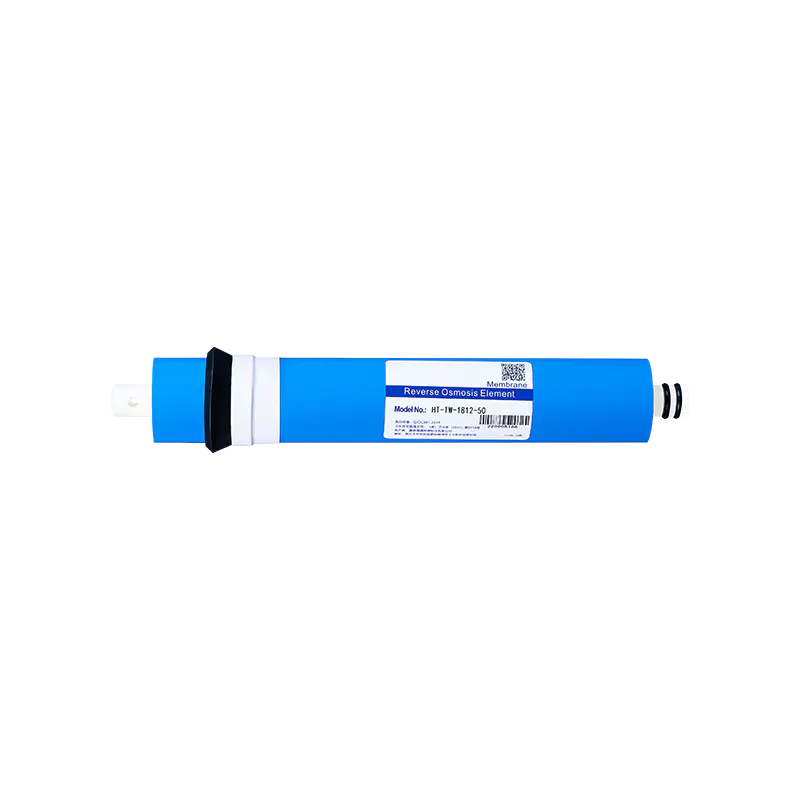 Kućanski membranski elementi reverzne osmoze za pročistače vode This RO membrane completes the filtration system described above, removing impurities, bacteria, and viruses. Odaberite između modela s različitim brzinama protoka i odbijanjem soli koji odgovaraju vašem sustavu. Pogledajte proizvod →
This is why a membrane should not be judged in isolation. Učinkovitost kompletnog sustava ovisi o zajedničkom radu svake komponente. Možete pročitati više o how RO membrane filter cartridges ensure pure drinking water u našem detaljnom vodiču.
Household vs. Industrijske RO membrane
Although the working principle is identical, membranes are engineered for very different scales and feed water conditions.
RO membrane za kućanstvo
Household membranes are compact spiral-wound elements, typically in 1812 or 2012 size packages, producing 50 to 100 gallons of permeate per day. They are designed for low pressure, high recovery, and simple replacement.
Industrial RO Membranes
Industrial elements, such as 4040 and 8040, are much larger and built for higher flow rates and tougher feed water. Specialized elements are available for different applications:
- Low-energy and extra-low-pressure membranes, such as the TW4040, reduce operating costs in brackish water treatment.
- Low-fouling, high-rejection brackish water membranes like the BW8040 resist organic and particulate fouling.
- Seawater desalination membranes such as the SW8040 are designed to reject salt at very high operating pressure.
 Industrial 4040 RO Membrane for High-Capacity Water Treatment A larger element designed for tougher feed water and higher flow rates. Available in anti-pollution, high-flux, or high-desalination types, offering stable desalination up to 99.6%. Pogledajte proizvod →
Choosing the right membrane means matching feed water quality, target permeate quality, and operating pressure, rather than simply picking the largest element available.
Savjeti za održavanje za produljenje vijeka trajanja membrane
RO membranes do not last forever, but with proper care, a household membrane can serve reliably for two to three years. Industrial membranes last even longer when the feed water is properly pretreated.
- Zamijenite predfiltere na vrijeme: Sediment and carbon cartridges protect the membrane from particles and chlorine. Neglecting them is the fastest way to damage the membrane.
- Redovito ispirite sustav: Automatic flushing solenoid valves help wash away rejected salts and foulants from the membrane surface.
- Pratite tlak i oporavak: Operating outside the design range accelerates scaling and shortens membrane life.
- Pazite na znakove starenja: A noticeable drop in permeate flow, higher TDS in the product water, or a change in taste indicates that it is time for replacement.
Understanding how an RO membrane works makes it easier to choose the right membrane type, design a reliable system, and troubleshoot performance issues. Membrana je srž reverzne osmoze, ali je i komponenta koja ima najviše koristi od odgovarajuće prethodne obrade, pritiska i održavanja.
Bez obzira birate li membranu za kućanstvo za pročišćivač pitke vode ili industrijski element za pročišćavanje bočate vode, pravilno odabiranje temelja uštedjet će vam vrijeme, vodu i novac. If you would like help identifying the right membrane for your application, kontaktirajte naš tim .


